
During the academic year 2009 – 2010, Hidden Sparks Coaches and Internal Coaches worked with 275 teachers, serving 320 classrooms, and discussed the strengths/struggles of an estimated 2,400 students.
Additional programs such as Hidden Sparks Without Walls and No Child Left Behind Title IIA Workshops supplied educators with additional opportunities and venues to deepen their understanding of struggling students and address the needs of even more students.
Hidden Sparks Without Walls Statistical Overview
Hidden Sparks Without Walls offers educators across the country, a new and convenient venue for professional development and growth, wherever they may be located. The Hidden Sparks Walls online courses feature leaders in a wide spectrum of educational areas who are eager to share their knowledge and expertise.
Since its inception in 2008-2009, Hidden Sparks Without Walls has offered 42 webinars with approximately 830 participating educators from over 90 Jewish Schools in 58 cities across 17 US States and 3 Canadian Provinces. Many of those educators who participate in one session enroll in additional webinars and recommend them to their coworkers and friends.
Hidden Sparks Without Walls provides practical tools to educators to deepen their understanding of struggling students and address the needs of all their students.
Reach
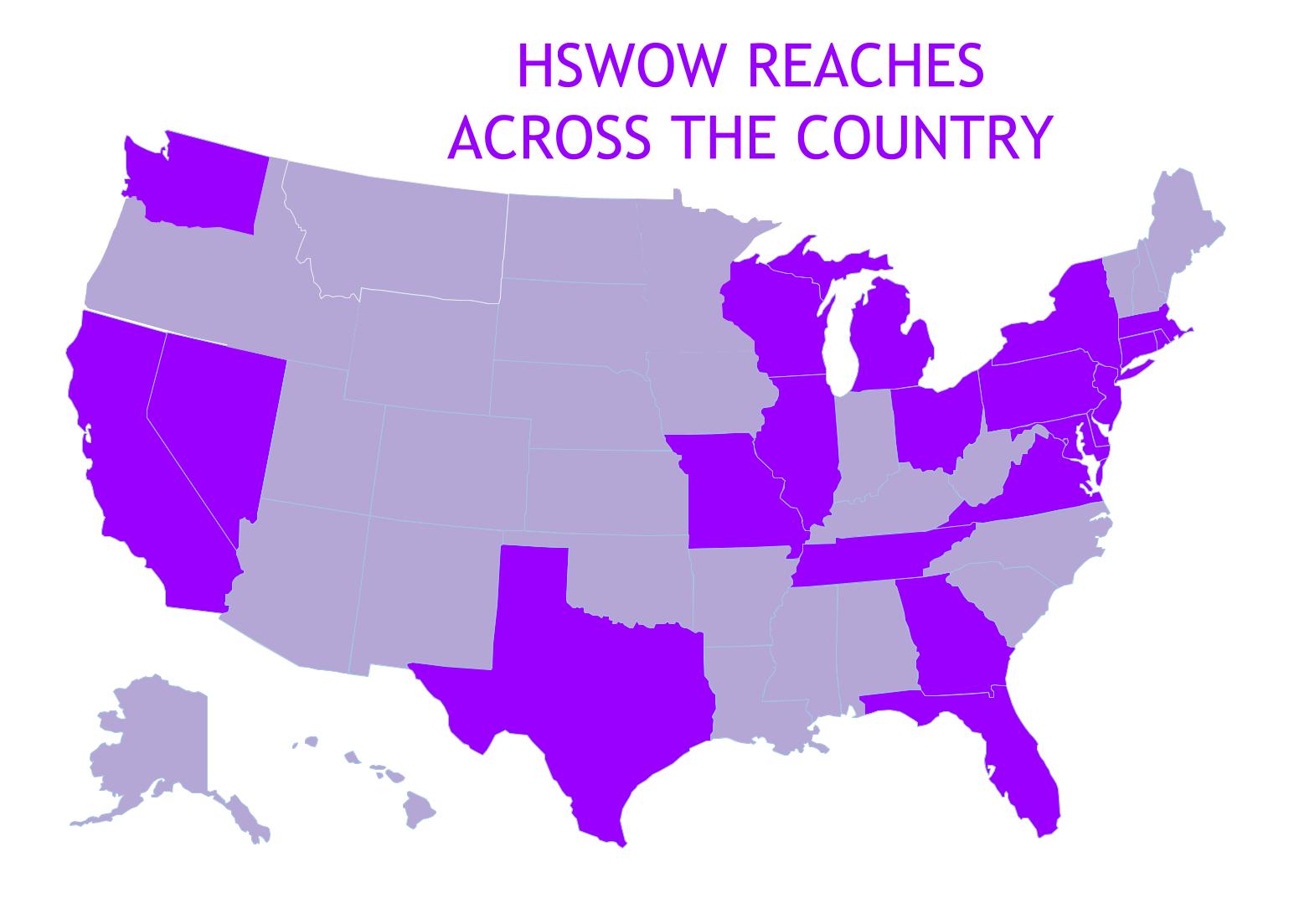
Since its inception HSWOW has attracted a strong following of educators interested in professional development. Initially participants in our webinars were entirely from New York and New Jersey. Today, the word is out about Hidden Sparks Without Walls! Educators from 17 States (California, Connecticut, Delaware, Florida, Maryland, Massachusetts, Michigan, Missouri, New Jersey, New York, Ohio, Pennsylvania, Rhode Island, Tennessee, Texas, Virginia, Washington) and 3 Canadian Provinces (British Columbia, Ontario, Quebec) have benefited and continue to benefit from Hidden Sparks webinars.
Shaded areas indicate those states with Hidden Sparks Without Walls participants
Loyalty
HSWOW webinar participants keep coming back for more! 37% of our educators who attend a webinar come back and attend again. 60% of those who attended one session in our inaugural year – 2008-2009 , joined us again in our second year and 25% joined us again in our third year. HSWOW participants also spread the word and recommend the sessions to their friends and co-workers.
Who Participates in HSWOW Webinars?
Many of those who enjoy participating in Hidden Sparks Without Wall courses are both secular and Judaic studies classroom teachers. In fact, approximately 69% of our participants are classroom teachers. But we have also had strong participation from principals, learning center coordinators, program directors, curriculum coordinators, school psychologists, student services directors, resource room specialists, speech-language pathologists, and administrators. Approximately 16% of participants work outside of the mainstream classroom in student and special services and 12% are administrators, the remaining 3% have other educational related roles.

Program Statistics
Academic Year 2009 -2010
During the academic year 2009 – 2010, Hidden Sparks Coaches and Internal Coaches worked with 275 teachers, serving 320 classrooms, and discussed the strengths/struggles of an estimated 2,400 students.
Additional programs such as Hidden Sparks Without Walls and No Child Left Behind Title IIA Workshops supplied educators with additional opportunities and venues to deepen their understanding of struggling students and address the needs of even more students.
Hidden Sparks Without Walls Statistical Overview
Hidden Sparks Without Walls offers educators across the country, a new and convenient venue for professional development and growth, wherever they may be located. The Hidden Sparks Walls online courses feature leaders in a wide spectrum of educational areas who are eager to share their knowledge and expertise.
Since its inception in 2008-2009, Hidden Sparks Without Walls has offered 42 webinars with approximately 830 participating educators from over 90 Jewish Schools in 58 cities across 17 US States and 3 Canadian Provinces. Many of those educators who participate in one session enroll in additional webinars and recommend them to their coworkers and friends.
Hidden Sparks Without Walls provides practical tools to educators to deepen their understanding of struggling students and address the needs of all their students.
Reach
Since its inception HSWOW has attracted a strong following of educators interested in professional development. Initially participants in our webinars were entirely from New York and New Jersey. Today, the word is out about Hidden Sparks Without Walls! Educators from 17 States (California, Connecticut, Delaware, Florida, Maryland, Massachusetts, Michigan, Missouri, New Jersey, New York, Ohio, Pennsylvania, Rhode Island, Tennessee, Texas, Virginia, Washington) and 3 Canadian Provinces (British Columbia, Ontario, Quebec) have benefited and continue to benefit from Hidden Sparks webinars.
Shaded areas indicate those states with Hidden Sparks Without Walls participants
Loyalty
HSWOW webinar participants keep coming back for more! 37% of our educators who attend a webinar come back and attend again. 60% of those who attended one session in our inaugural year – 2008-2009 , joined us again in our second year and 25% joined us again in our third year. HSWOW participants also spread the word and recommend the sessions to their friends and co-workers.
Who Participates in HSWOW Webinars?
Many of those who enjoy participating in Hidden Sparks Without Wall courses are both secular and Judaic studies classroom teachers. In fact, approximately 69% of our participants are classroom teachers. But we have also had strong participation from principals, learning center coordinators, program directors, curriculum coordinators, school psychologists, student services directors, resource room specialists, speech-language pathologists, and administrators. Approximately 16% of participants work outside of the mainstream classroom in student and special services and 12% are administrators, the remaining 3% have other educational related roles.